


Summers are like that in Greenland; you never know what awaits you. What can I expect this year? I ask myself this question every time I pack my bag. Needless to say, I tend to pack too many warm clothes.
My first Greenland summer initially treated me very gently. Sunny, warm, a slight breeze! This is a beautiful Arctic summer, I thought. But after just two days, I couldn’t keep the mosquitoes away, and no amount of fancy insect repellents could stop them. The only solution I came up with after a while was to constantly keep moving, preferably near a glacier—there were no mosquitoes there. Time slowly passed, and it was still bright outside, but it wasn’t the sun that kept me awake. These small, bloodsucking beasts had entered my room through the mosquito net. I immediately remembered the words of the Dalai Lama XIV: “If you think you’re too small to make a difference, try sleeping in the presence of a mosquito. I’ve tried it, I’ve tested it. It’s impossible!” The life-and-death struggle began around midnight and lasted a good two hours. And as I write this, the undisputed winner is me! Finally, it was quiet, though I could still hear the buzzing in my head for a while. And the peace? Well, now it looked more like a bloody landscape after a battle with enemies nailed to the wall.
Another summer brought constant fog, snow, and rain. One trip stands out in my memory: we sailed by boat to the Eqi Glacier. Summer is a bit late this year; the fjord hasn’t thawed yet, and as a result, we’re stuck in ice soup. We can’t go any further. The soup is getting thicker, and the ice dumplings are starting to press against each other, blocking our path. It’s important to remember that we’re not aboard a giant icebreaker, but a twelve-meter Targa 35. The captain has turned off the engine. We’re drifting through the ice, bathed in thick fog. Whichever way we look, the view is the same. There’s nothing left for us here; it’s time to return to Ilulissat. The return is long and slow. Maneuvering through the ice is not easy and requires great precision. The real challenge, however, awaits us near the shore, where a lot of ice has accumulated, and above all, icebergs, which are difficult to squeeze through. Complete concentration, silence on board, the captain searches for the best route, while the nervous passengers keep a watchful eye. Several times we had to turn around and change course. After an hour, we managed to escape the ice labyrinth and dock safely. I must admit, I felt relief as soon as I stepped onto land. With the ice also came a cooling sensation. The most important thing is that there are no mosquitoes.
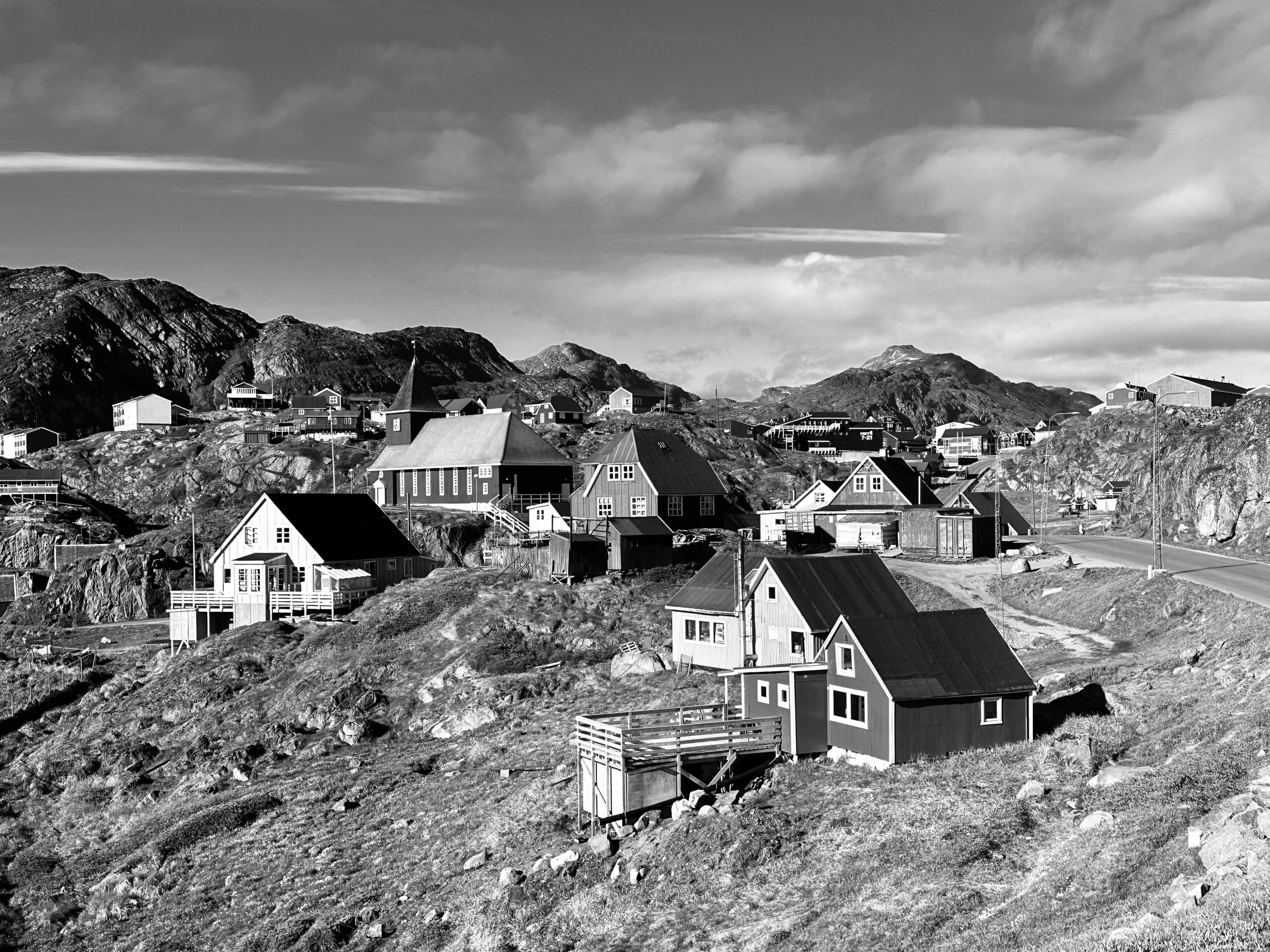
A year later, in Sisimiut, I understood why Greenland is actually Greenland. Greenland literally means green land. Looking through satellite images of our Earth, it’s hard to miss Greenland. It’s a large, white spot. Over 80% of the island is covered by an ice sheet. According to an Icelandic saga, Erik the Red, exiled from Iceland, discovered a new land and named it the green land to encourage the Vikings to settle there. Summer in Sisimiut is exceptionally warm this year. Colorful houses bathed in the sun shimmer with all the colors of the rainbow. This small town is located too far from the glaciers, so you won’t find any floating icebergs here. However, beautiful grassy hills, here and there covered with dandelions, will appear before our eyes. So the green land of Erik the Red really does exist. The sun has been shining constantly for several days now, and during the Arctic summer it doesn’t set below the horizon. Sisimiut is teeming with life, but I’m very sorry, could someone please finally turn off this light?